
Loading...
Published on March 28, 2026 By 800ZED

You graduated. You got the job, or you are working on it. You are doing everything you were told you were supposed to do.
So why do you feel like you are running on fumes?
Why does getting out of bed feel like a battle some mornings? Why does Sunday feel heavier than it should? Why are you so tired of everything when you have barely even started?
Here is the thing nobody told you when you were hustling through school, internships, and family expectations all at once. Burnout does not wait until you are 40 and deep into a career. For your generation, it arrives much, much earlier.
A 2025 survey found that 25% of people experience burnout before they turn 30. For Gen Z and millennials specifically, peak stress now hits at an average age of just 25 years old, younger than any generation on record. And a global study of over 13,000 workers found that 83% of Gen Z employees reported feeling burned out, significantly higher than the 75% burnout rate among older age groups.
You are not lazy. You are not ungrateful. You are not weak.
You are burned out. And there is a real difference.
Burnout gets thrown around so casually that it has almost lost its meaning. "I'm so burned out from that project" gets said in the same breath as "I'm burned out from this TV show." But clinical burnout is something more specific and more serious than a bad week or a heavy workload.
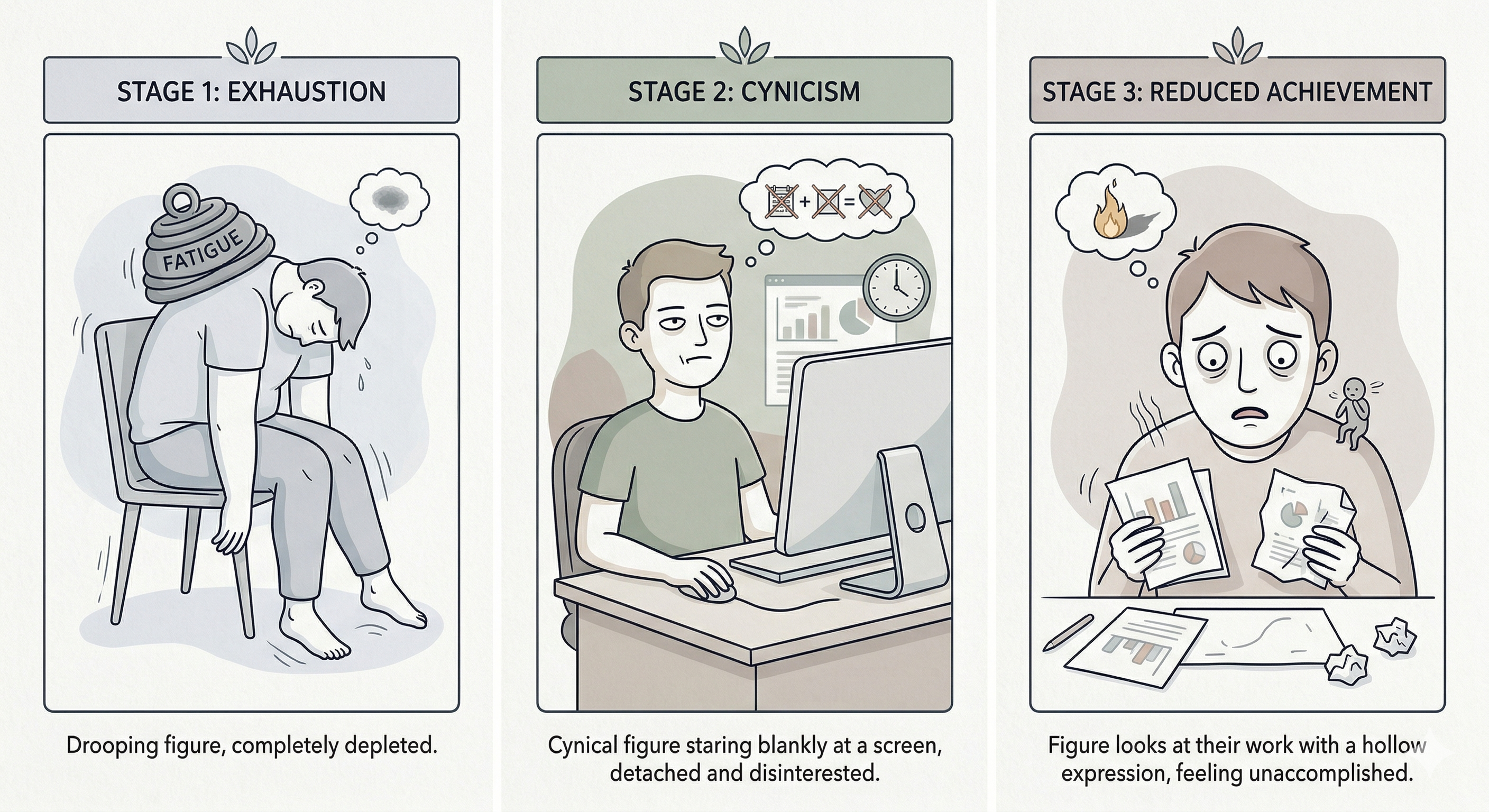
The World Health Organization classifies burnout as an occupational syndrome resulting from chronic stress that has not been successfully managed. It shows up across three distinct dimensions:
Exhaustion. Not just tired, but a deep, pervasive depletion that rest does not fix. You sleep eight hours and wake up feeling like you did not sleep at all.
Cynicism and detachment. A growing sense of distance from your work, your goals, and sometimes the people around you. Things that used to matter start to feel pointless. You go through the motions but feel nothing.
Reduced sense of achievement. The feeling that nothing you do is ever enough, that your effort is wasted, or that you are failing even when the evidence says otherwise.
If all three of those sound uncomfortably familiar, you are not imagining it.
 This is not a generation that is too soft or too entitled. That narrative is both lazy and wrong. The research tells a very different story.
You entered adulthood during one of the most destabilizing periods in modern history.
Many young Filipinos finished school or entered the workforce during or just after the COVID-19 pandemic, which in the Philippines meant one of the longest and strictest lockdowns in the world.
The informal learning, the peer support, the gradual on-ramp into professional life that previous generations took for granted, your generation largely missed all of that. You were thrown into deep water and told to swim.
The financial pressure on young Filipinos is genuinely crushing.
The AXA 2025 Mind Health Report found that financial instability and job insecurity was the number one stressor for young Filipinos, reported by 76% of respondents. This is not abstract worry. This is the reality of navigating rising costs, unstable job markets, contract work, and in many cases, being expected to financially support family members while barely getting started yourself.
The always-on culture has no off switch.
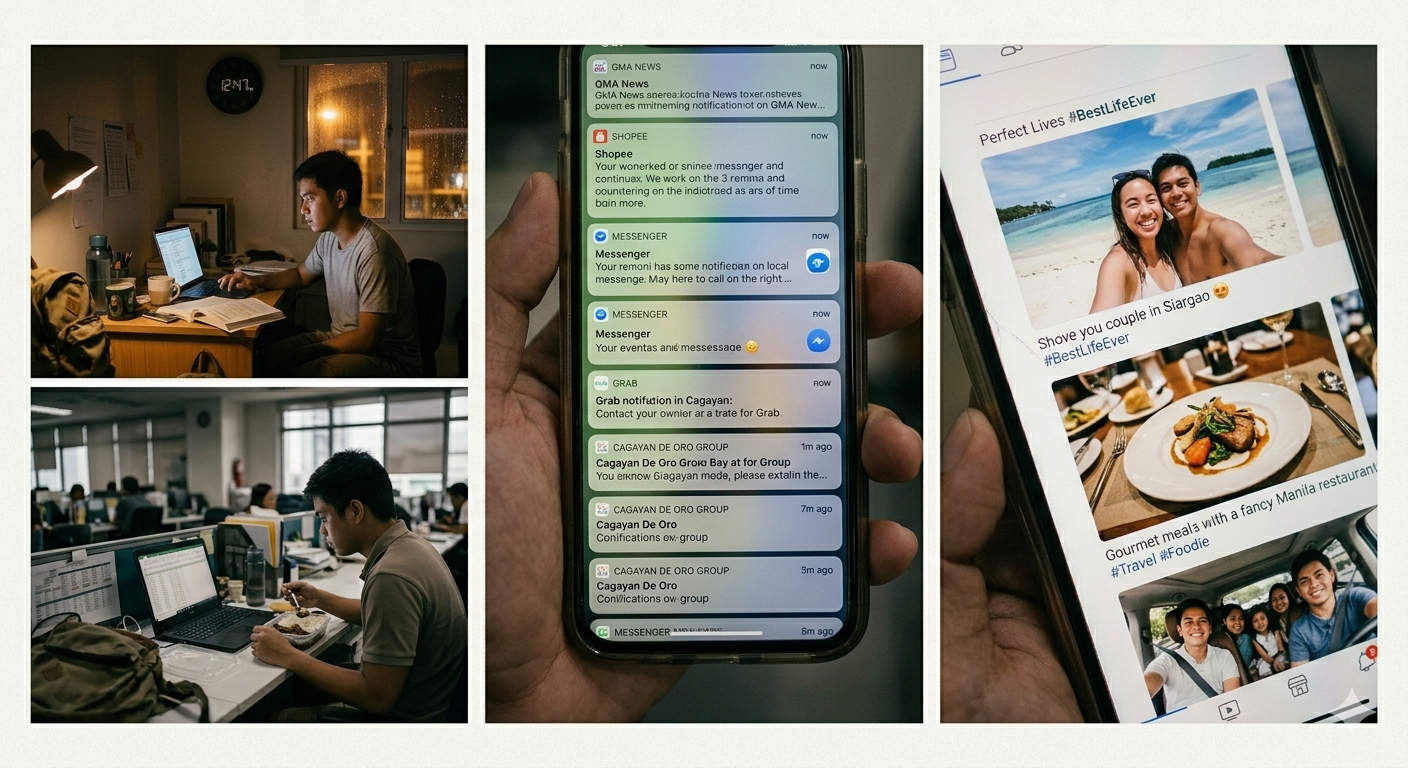
Work follows you home through your phone. Notifications do not stop at 5PM. The boundary between rest time and work time has collapsed almost completely for young workers, especially those in remote or hybrid setups. A 2026 study found that poor work-life balance is one of the primary drivers of burnout in young workers, alongside excessive workloads and unclear job expectations.
Social media adds a layer of pressure that previous generations never had.
You are not just managing your actual life. You are also managing the perception of your life. The curated highlight reels of peers who seem to be achieving more, earning more, and enjoying more create a constant low-level sense of falling behind. That comparison is exhausting in ways that are hard to articulate but very real in their effects.
The hustle culture myth told you rest was weakness.
The grind mentality that dominated social media for years told an entire generation that the answer to feeling overwhelmed was to push harder. Work more. Sleep less. Hustle until it hurts. For many young Filipinos who grew up watching that messaging, and who also carry the deep cultural weight of being the family's investment and hope, stepping back to rest can feel like betrayal. So they push through. And they burn out faster.
87% of Filipino workers report work-related mental health struggles, and younger workers are disproportionately affected. MindNation, a Philippine mental health organization, reported that stress levels among Filipinos rose from 57% in 2022 to 72% in 2024, a dramatic jump in just two years.
And when burnout goes unaddressed long enough, it does not stay as burnout. It is one of the leading pathways into the youth mental health crisis that is quietly affecting 1 in 5 young Filipinos right now.
Burnout in young people does not always announce itself dramatically. It creeps in slowly, so slowly that many people normalize the symptoms for months or even years before recognizing what is happening.
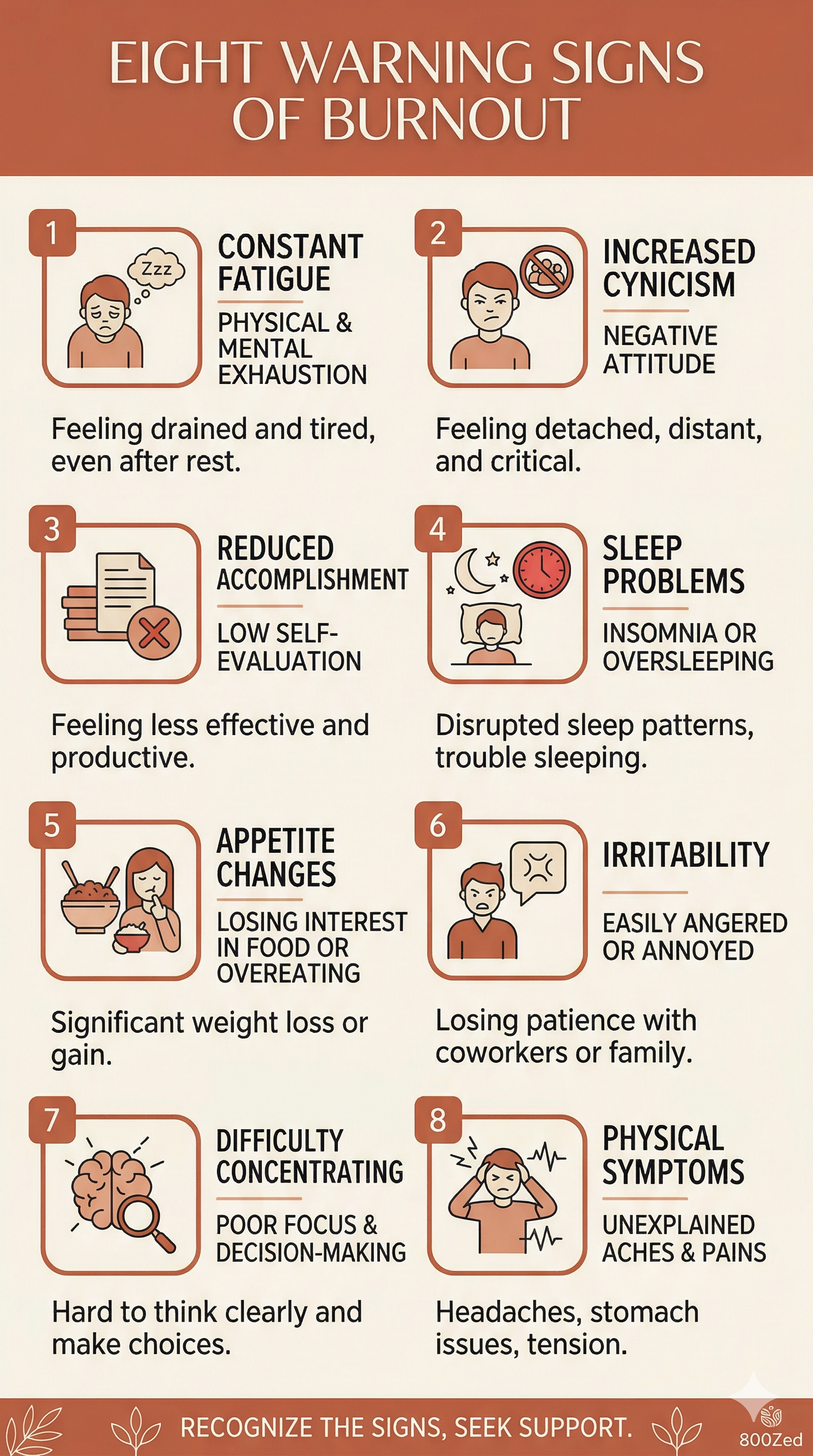
Watch for these signs:
Chronic exhaustion that sleep does not fix.
You are tired before the day begins. You count down to the weekend on Monday morning. Vacations and rest days help temporarily, but the fatigue comes back the moment the pressure returns.
Dreading things you used to enjoy or feel neutral about.
Work, hobbies, socializing. Things that used to feel manageable or even enjoyable now feel like obligations you have to force yourself through.
Emotional numbness or detachment.
You stop caring the way you used to. Deadlines that once motivated you feel meaningless. You do just enough to get by and feel nothing about it either way.
Increased irritability and short fuse.
Small things that would not have bothered you before now tip you over the edge. You snap at people you care about. You feel frustrated constantly without always knowing why.
Difficulty concentrating and making decisions.
Brain fog, inability to focus, forgetting things, taking much longer than usual to complete simple tasks. Burnout physically affects cognitive function. It is not just in your head, it is in your brain chemistry.
Physical symptoms.
Frequent headaches, stomach problems, getting sick more often, changes in sleep patterns or appetite. Burnout lives in the body. The physical symptoms are real and they compound over time.
Pulling away from people.
Canceling plans, going quiet in group chats, preferring isolation not because you genuinely want solitude but because human interaction feels like one more demand on a system that is already overloaded.
Feeling like nothing will ever change.
This is one of the most dangerous signs. The quiet hopelessness that says no matter what you do, things will stay the same. This is where burnout and depression in young filipinos begin to overlap, and where getting professional support becomes genuinely important.
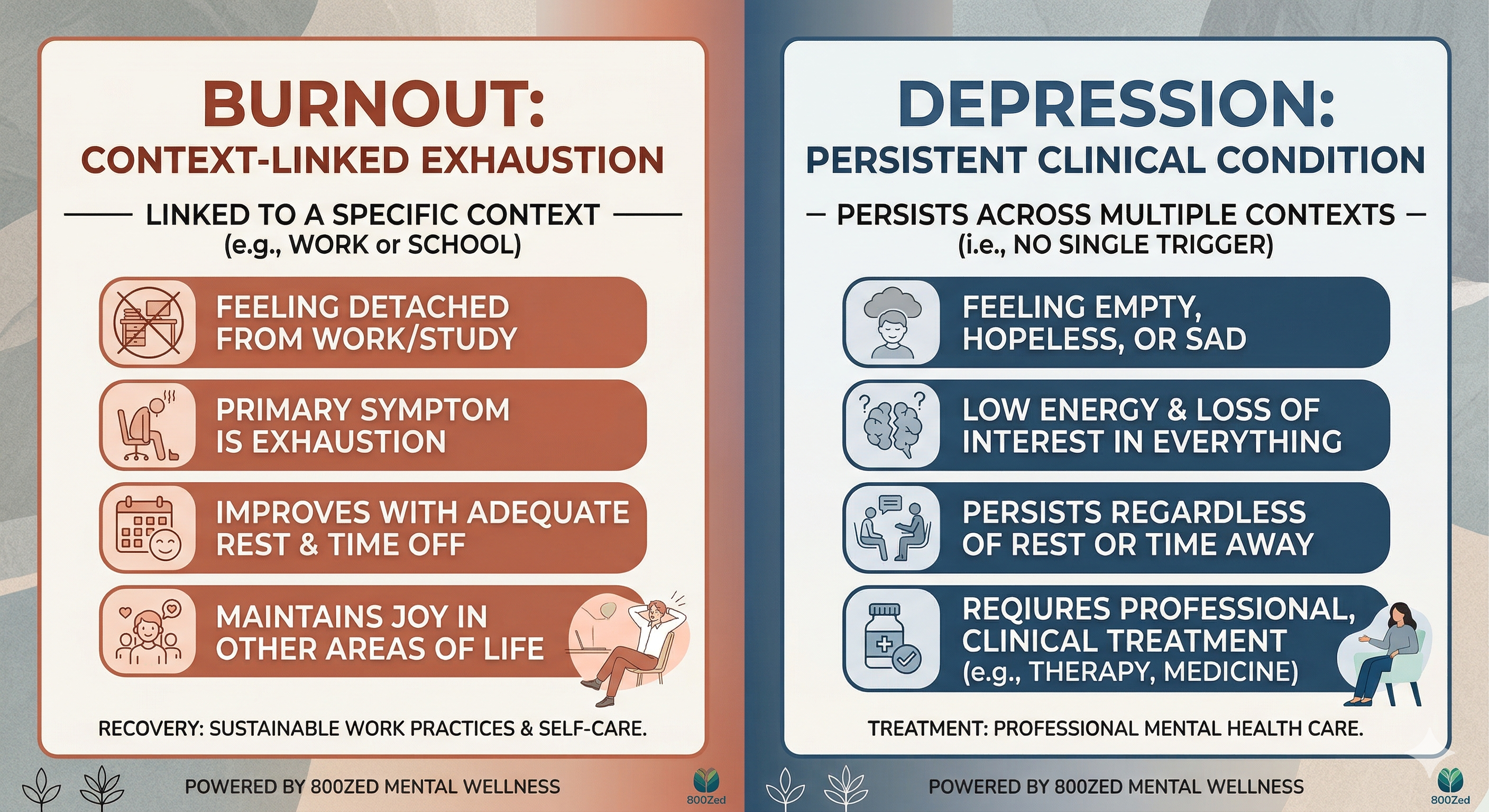
This distinction matters because the two conditions overlap significantly, and because mistaking one for the other can lead to the wrong kind of help.
Burnout is primarily context-driven. It is rooted in external circumstances, an overwhelming job, impossible expectations, chronic overwork, a life with no room to breathe. When those circumstances change, burnout typically improves. Rest, boundaries, and removing the source of chronic stress are the primary treatments.
Depression is a clinical condition that affects mood, cognition, and physical health regardless of circumstances. It does not lift when the workload eases. It persists across contexts and often requires professional treatment, whether that is therapy, medication, or both.
Here is the complication. Burnout can develop into depression if left unaddressed long enough. Chronic exhaustion and hopelessness, sustained over months or years, can push the brain into a depressive state that outlasts the original stressors. This is why catching burnout early, before it crosses into something deeper, is so important.
Want to understand what depression in young filipinos actually looks like? We wrote about it
in depth.... because knowing the difference could change everything.
If you are experiencing hopelessness, loss of interest in things outside of work, or thoughts of self-harm alongside your exhaustion, please reach out to a doctor or mental health professional rather than waiting to see if rest fixes it.
The internet is full of advice about burnout recovery that basically amounts to "take a bath and do yoga." That is not what this is.
Real recovery from burnout requires addressing both the symptoms and the source. Here is what the research actually supports:
Start by acknowledging it out loud.
One of the most powerful first steps is simply naming what is happening. Not "I'm just tired" or "work is just stressful right now." Say it to yourself, write it down, or tell someone you trust: I am burned out. That naming is not giving up. It is the beginning of taking it seriously.
Rest is not a reward. It is medicine.
Resting before you have finished everything, before you have earned it, before you have hit a milestone — that is not laziness. It is a basic biological need. Your nervous system cannot recover while it is still in a chronic state of activation. Real rest means full disconnection. Not scrolling social media on the couch, but genuinely stepping away from the demands that are draining you.
Set boundaries and mean them.
Boundaries are not about being difficult or uncooperative. They are about defining the limits of what you can sustainably give. Saying no to an additional project, not answering work messages after a certain hour, protecting one day a week as genuinely yours. These are not luxuries. They are part of recovery and prevention.
Move your body, but gently.
Intense exercise can actually worsen burnout symptoms in the acute phase because it adds physical stress to an already depleted system. But gentle, consistent movement, walking, swimming, stretching, light cycling, has strong evidence behind it as a burnout and depression recovery tool. Start small. Ten minutes outside counts.
Rebuild social connection intentionally.
Isolation makes burnout worse. But the overcrowded social calendar of early 20s life is not the answer either. Identify one or two people who genuinely refuel you rather than drain you, and prioritize those connections over obligation socializing.
Address the source, not just the symptoms.
If the job is genuinely unsustainable, if the workload is impossible, the environment is toxic, or the expectations are unmanageable, recovery will keep hitting a ceiling until something about the situation changes. This might mean a difficult conversation with a manager, a restructuring of responsibilities, or in some cases, a decision to leave. That is not failure. That is self-preservation.
Talk to a professional.
If your burnout has been building for months, if it is affecting your physical health, your relationships, or your ability to function day to day, please do not try to manage it alone. A doctor can help you assess where you are, rule out underlying conditions like depression or anxiety that may be compounding the exhaustion, and point you toward the right kind of support. A telemedicine consultation means you can do this from home, privately, without having to navigate a waiting room on a day when you barely have the energy to shower.
There is a specific kind of burnout that comes with being a young Filipino in your 20s that does not get talked about enough.
Many of you are not just managing your own life. You are managing family expectations, financial contributions, the weight of being the one who was supposed to make it, the guilt of wanting rest when others sacrificed so much to get you here. The cultural pressure to keep going, to not complain, to be grateful and productive and present, all at once, is enormous.
And on top of that, you are doing it in a country where the systems that are supposed to support young people, stable jobs, affordable housing, accessible mental health care, are still catching up with the need.
You are not failing. You are carrying too much. There is a difference.
The bravest thing you can do right now is not push harder. It is ask for help. Whether that means talking to someone you trust, booking a consultation with a doctor, or simply letting yourself rest without guilt for one afternoon.
Your 20s are supposed to be the foundation of the rest of your life. Burning them out in a blaze of exhaustion is not what anyone who loves you wants for you.
You deserve to build something sustainable. Starting now. 💙

Book a telemedicine consultation with 800Zed today, privately, from home, with a doctor who can help you figure out where to start.
📞 NCMH Crisis Hotline: 1553. Available 24/7. Free. Confidential
_______________
Stay connected with the 800ZED Blog! Get the latest health tips, wellness insights, and simple daily habits that can boost your well-being — from your sleep routine to your screen time. Subscribe now and take small steps toward a healthier, happier you.

Copyright © 2026 by 800zed. All Rights Reserved.
We use cookies to give you the best service on our site. By continuing to use the site you consent to our Privacy Policy
📲 Install 800 ZED App for quick access!
📲 Install 800 ZED App on your iPhone
Tap Share → Add to Home Screen
📲 Install 800 ZED on Firefox
Open menu ☰ → Install
Subscribe our newsletter for latest updates
Get the latest updates, promotions, and news delivered straight to your inbox.